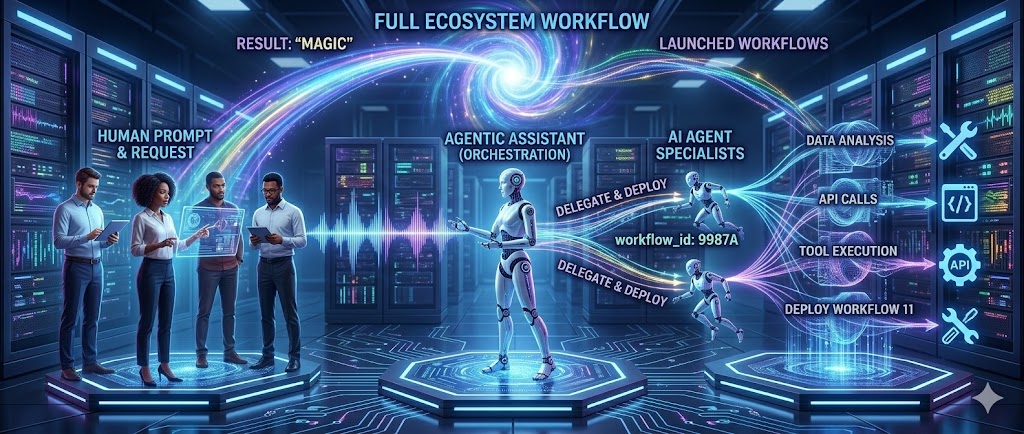
Anatomy of a Conversation
From voice input to verifiable audit trail - follow a single conversation as it flows through every protocol layer, agent delegation, human approval gate, and tamper-evident log entry.

Reason
AgentsQuoxMindAgentic TeamsMirrorQuoxLensRemember
QuoxMemoryBrain2CompoundingQuoxPlanCodebase MirrorAct
QuoxFlowQuoxEngineQuoxAgentQuoxChatAutonomyRun
EnterpriseOrganisationsPowers & ToolsmithQlusterQuoxBastionInterfaces
QuoxMCPQuoxCLIQuoxTerminalQuox ConsoleQuoxBoxGovern
HITL ApprovalsQuox SecurityAgent HonestyQuoxVaultAI GovernanceAgentic AIProve
For AuditorsVerifiable AI OpsLoggingEU AI ActCompliance SuiteChannels
Matrix RoomsDiscord ProTelegram ProQuoxSignalCoreCommsAll products A-ZBuild
QuoxProofDeveloper KitPlugin SDKBring your tool to QuoxQuoxpertQuoxSkillsQlarityShip and sell
Build and sellBrowse MarketplaceDownloadsProtocolsDev Suite
Dev ServersQuoxBuildQuoxSlotsShared Skills + RulesDev workflow
RepoBrainGripeTriageFixLoopProofLoopDoneEngineAll products A-ZGet started
OverviewArchitectureProtocols
AEEAOCLVOLTWARDReference
GlossaryAPI ReferencePlugin SDKDockerAll products A-ZFrom voice input to verifiable audit trail - follow a single conversation as it flows through every protocol layer, agent delegation, human approval gate, and tamper-evident log entry.

What actually happens between the moment you speak a request and the moment you get an answer? In most AI systems, the answer is: nobody knows. The request goes in, something happens in a black box, and a response comes out. There is no trace, no audit trail, no proof of what happened, who approved what, or whether the system followed its own rules.
We built four open protocols to change that. AEE (Agent Envelope Exchange) gives every message a structured, traceable identity. AOCL (Agent Orchestration Control Layers) routes each request through a governed pipeline of safety checks, planning, and delegation. VOLT (Verifiable Operations Ledger & Trace) creates a tamper-evident, hash-chained record of everything that happened.
And WARD (Write-once Append-only Receipt Digests) produces content-free witness receipts that prove events existed, even if the original evidence is destroyed.
This article is a walk-through of a single, real-world conversation. Not a simplified example. A complex one. Voice input, multi-agent delegation, tool execution, human-in-the-loop approval, workflow orchestration, and a final evidence bundle that proves every step. The article you're reading is, itself, the audit trail.
Hey CommanderQ, our production API response times have spiked in the last hour. Can you check what's going on and fix it if you find the problem?
A DevOps engineer, Adam, speaks into his QuoxTerminal. It's 2:32 PM UTC. The production API is serving 23x slower than normal. He doesn't know why yet. He just knows something is wrong and he wants his AI assistant to find and fix it.
What follows is a 67-second journey through 13 steps, 11 AOCL layers, 4 tool calls, 1 human approval, 5 workflow nodes, 22 hash-chained VOLT events, and a WARD witness receipt chain.
Follow the conversation as it flows from voice input through every protocol layer to its final, verified resolution.
Phase: Voice Input · Timing: +0ms
The journey begins when a DevOps engineer speaks into their terminal. The microphone captures raw audio - a natural language request driven by urgency. No typing, no forms, no menus. Just a human voice asking for help.
Phase: Transcription · Timing: +340ms
The audio is sent to a speech recognition service. Within milliseconds, the waveform becomes text, a structured transcript with a confidence score. This is the first transformation: from analog signal to digital intent.
{
"v": "1",
"id": "01JQ7M3K-STT-RSLT-001",
"ts": "2026-03-03T14:32:00.340Z",
"type": "result",
"from": "service.whisper",
"to": "agent.commanderq",
"intent": "voice.transcribe",
"corr": "01JQ7M3K8X5Y2Z9W1A4B6C8D3E",
"reply_to": "01JQ7M3K-STT-TASK-001",
"priority": "normal",
"payload": {
"transcript": "Hey CommanderQ, our production API response times have spiked in the last hour. Can you check what's going on and fix it if you find the problem?",
"confidence": 0.97,
"language": "en",
"duration_ms": 3200
},
"sig": null
}Phase: AEE · Timing: +345ms
Now the transcript becomes a proper AEE envelope, a structured, 14-field JSON message that any agent in the system can understand. This is the moment raw human language enters the protocol layer. The envelope carries everything needed for routing, correlation, and accountability.
{
"v": "1",
"id": "01JQ7M3K-MAIN-TASK-001",
"ts": "2026-03-03T14:32:00.345Z",
"type": "task",
"from": "human.adam",
"to": "agent.commanderq",
"intent": "ops.api.performance.investigate",
"corr": "01JQ7M3K8X5Y2Z9W1A4B6C8D3E",
"reply_to": null,
"trace": { "trace_id": "9f3c4a7b", "span_id": "a12b8e91" },
"priority": "high",
"requires": {
"timeout_ms": 120000,
"human_approval": true,
"evidence": true
},
"payload": {
"transcript": "Hey CommanderQ, our production API response times have spiked in the last hour. Can you check what's going on and fix it if you find the problem?",
"source": "voice",
"source_confidence": 0.97,
"context_hints": ["production", "api", "performance", "spike"]
},
"sig": null
}Phase: AOCL (L0, L1) · Timing: +353ms
The envelope enters the AOCL (Agent Orchestration Control Layers) stack. Layer 0 normalizes the input, creating a unique run ID, recording the channel (terminal voice), and preparing the context bundle. Layer 1 resolves identity: who is this user, what are their permissions, and what redaction rules apply?
{
"v": "1",
"id": "01JQ7M3K-AOCL-L1-001",
"ts": "2026-03-03T14:32:00.353Z",
"type": "event",
"from": "agent.commanderq",
"to": "log.aocl",
"intent": "aocl.layer.decision",
"corr": "01JQ7M3K8X5Y2Z9W1A4B6C8D3E",
"reply_to": "01JQ7M3K-MAIN-TASK-001",
"priority": "normal",
"payload": {
"run_id": "RUN-01JQ7M3K-001",
"layer": { "id": "L1.identity.scope", "version": "0.1" },
"timing_ms": 8,
"decisions": [
{ "code": "SCOPED", "reason": "Admin identity verified; ops tools permitted" }
],
"delta": {
"C0.Event.channel": "terminal-voice",
"C0.Event.source": "voice-transcription",
"C1.Identity.actor": "human.adam",
"C1.Identity.role": "admin",
"C4.Policy.allowed_tools": ["tool.ops.*", "tool.readonly.*"],
"C6.Audit.redaction_ruleset": "default-v1"
},
"control": { "halt_pipeline": false }
},
"sig": null
}Phase: AOCL (L2, L3) · Timing: +362ms
Layer 2 checks for a "fast path", a cached response or deterministic shortcut that can skip the heavier layers. This request is too complex for a shortcut, so it continues. Layer 3 is the policy gate, the critical safety checkpoint. It evaluates the request against compliance rules and determines: investigation is allowed, but any production changes require human-in-the-loop approval.
{
"v": "1",
"id": "01JQ7M3K-AOCL-L3-001",
"ts": "2026-03-03T14:32:00.362Z",
"type": "event",
"from": "agent.commanderq",
"to": "log.aocl",
"intent": "aocl.layer.decision",
"corr": "01JQ7M3K8X5Y2Z9W1A4B6C8D3E",
"reply_to": "01JQ7M3K-MAIN-TASK-001",
"priority": "normal",
"payload": {
"run_id": "RUN-01JQ7M3K-001",
"layer": { "id": "L3.policy.gate", "version": "0.1" },
"timing_ms": 9,
"decisions": [
{ "code": "POLICY_ALLOW", "reason": "Read-only investigation tools permitted" },
{ "code": "HITL_FLAGGED", "reason": "Production writes require human approval" }
],
"delta": {
"C4.Policy.investigation_mode": "allowed",
"C4.Policy.production_writes": "hitl_required",
"C5.Execution.mode": "investigate-then-approve"
},
"control": { "halt_pipeline": false, "require_hitl": true }
},
"sig": null
}Phase: AOCL (L4, L5) · Timing: +380ms
Layer 4 decomposes the request into a structured plan: diagnose, propose, remediate. Each phase has clear objectives and constraints. Layer 5 retrieves relevant context, recent deployment history, system architecture, and past incident records. This is where the system's memory informs its reasoning.
Phase: AOCL (L6, L7) · Timing: +395ms
Layer 6 shapes the plan into concrete delegation tasks, preparing AEE envelopes with the right context refs and constraints. Layer 7 dispatches the work: a task envelope is sent to the diagnostics agent, carrying everything it needs to investigate without further context-loading.
{
"v": "1",
"id": "01JQ7M3K-DLGT-TASK-001",
"ts": "2026-03-03T14:32:00.395Z",
"type": "task",
"from": "agent.commanderq",
"to": "agent.ops-diagnostics",
"intent": "ops.api.performance.diagnose",
"corr": "01JQ7M3K8X5Y2Z9W1A4B6C8D3E",
"reply_to": "01JQ7M3K-MAIN-TASK-001",
"priority": "high",
"requires": { "timeout_ms": 60000, "evidence": true },
"payload": {
"target_service": "api",
"symptoms": ["latency_spike", "p99_elevated"],
"window": "1h",
"context_refs": [
"mem://deploys/recent",
"mem://incidents/similar",
"inv://services/api/architecture"
]
},
"sig": null
}Phase: Agent · Timing: +420ms → +4.2s
The diagnostics agent goes to work. It executes four tool calls in sequence, each producing evidence that builds toward a root cause. Every tool call is itself an AEE task/result pair, sharing the same correlation ID.
| Tool | Purpose | Result | Finding |
|---|---|---|---|
| 📊 Prometheus | Query API latency metrics | p99 latency: 4,200ms (baseline: 180ms) | Latency 23x above normal for last 47 minutes |
| 📝 PostgreSQL Logs | Analyze database error logs | FATAL: too many clients already | 312 occurrences in last hour, first at 13:45 UTC |
| 🔌 Connection Pool | Check pool status via pg_stat_activity | active: 10/10, idle: 0, waiting: 47 | Pool exhausted - all connections in use, 47 queries queued |
| 🚀 Deploy History | Check recent deployments | v2.4.1 deployed 18h ago - ORM library update | New ORM version holds connections open across request boundaries |
Root cause: The ORM update (v2.4.1, deployed 18 hours ago) changed connection handling behavior. Instead of releasing connections after each query, the new version holds them across request boundaries. With a pool max of 10, the pool was exhausted once traffic exceeded 10 concurrent requests, causing all subsequent queries to queue.
Phase: AOCL (L8) · Timing: +4.3s
Layer 8 verifies the agent's findings. Four independent tool results all corroborate the same root cause. The evidence refs check out. The confidence score exceeds the threshold. The diagnosis is verified and the proposed fix can proceed, pending human approval.
Phase: HITL · Timing: +4.4s → +19.7s
The agent has a diagnosis and a proposed fix. But this is a production system. The AOCL policy gate flagged this: production writes require human approval. The system pauses and presents the proposed changes to Adam for review.
Approval required: production write operation, policy requires human sign-off. Proposed changes: increase connection pool 10 to 50; set connection idle timeout to 30s; rolling restart of 3 API pods, one at a time. Evidence: 4 tool results confirming pool exhaustion. Expires in 5 minutes. Human decision: approved by human.adam ("Looks good, proceed with the fix"), decision time 15.3 seconds.
{
"v": "1",
"id": "01JQ7M3K-HITL-APR-001",
"ts": "2026-03-03T14:32:19.700Z",
"type": "result",
"from": "human.adam",
"to": "agent.commanderq",
"intent": "hitl.approval.respond",
"corr": "01JQ7M3K8X5Y2Z9W1A4B6C8D3E",
"reply_to": "01JQ7M3K-HITL-REQ-001",
"priority": "urgent",
"payload": {
"request_id": "hitl-req-001",
"decision": "approved",
"approved_by": "human.adam",
"comment": "Looks good, proceed with the fix"
},
"sig": null
}Phase: QuoxFlow · Timing: +20s → +67s
With approval granted, the system triggers a QuoxFlow workflow: "incident-remediation." This isn't an ad-hoc sequence of commands, it's a registered, versioned workflow with defined steps, rollback procedures, and health checks. Each node executes in order, and every action is logged.
Phase: Response (L9, L10) · Timing: +67.5s
Layer 9 assembles the final response, compiling the diagnosis, the actions taken, and the current system status into a clear, human-readable summary. Layer 10 writes the audit trail: persisting the conversation to memory, emitting the VOLT evidence bundle, and closing the AOCL run.
{
"v": "1",
"id": "01JQ7M3K-FNL-RSLT-001",
"ts": "2026-03-03T14:32:67.500Z",
"type": "result",
"from": "agent.commanderq",
"to": "human.adam",
"intent": "ops.api.performance.investigate",
"corr": "01JQ7M3K8X5Y2Z9W1A4B6C8D3E",
"reply_to": "01JQ7M3K-MAIN-TASK-001",
"priority": "high",
"payload": {
"status": "resolved",
"summary": "Production API latency spike resolved. Root cause: ORM v2.4.1 connection leak causing pool exhaustion. Fix applied: connection pool increased to 50, idle timeout set to 30s, API pods restarted. Current p99 latency: 165ms.",
"root_cause": "ORM library update (v2.4.1) changed connection handling - connections held across request boundaries instead of being released per-query",
"actions_taken": [
"Connection pool size: 10 → 50",
"Connection idle timeout: 30s (new)",
"Rolling restart of 3 API pods",
"Team notified via Slack"
],
"current_status": {
"p99_latency_ms": 165,
"active_connections": 8,
"pool_utilization": "16%",
"waiting_queries": 0
},
"confidence": 0.94,
"evidence_refs": [
"log:prometheus:api-latency-query",
"log:postgresql:error-log-analysis",
"log:pgstat:connection-pool-status",
"log:deploy:v2.4.1-changelog"
]
},
"sig": null
}Phase: WARD · Timing: +67.6s
The conversation is complete, but there is one final step. WARD (Write-once Append-only Receipt Digests) produces content-free witness receipts for the entire chain of events. Unlike VOLT, which stores what happened, WARD stores only that something happened: cryptographic hashes with no payload content. If the VOLT ledger is tampered with, or even destroyed entirely, the WARD receipts still prove the original events existed.
This is the difference between recording evidence and witnessing it.
{
"v": "1",
"id": "01JQ7M3K-WARD-WIT-001",
"ts": "2026-03-03T14:32:67.600Z",
"type": "event",
"from": "ward.witness",
"to": "log.ward",
"intent": "ward.receipt.batch",
"corr": "01JQ7M3K8X5Y2Z9W1A4B6C8D3E",
"priority": "normal",
"payload": {
"chain_id": "ward:collector:primary",
"batch_size": 3,
"receipts": [
{ "seq": 1, "source": "aee", "hash": "sha256:7a3f2e...", "prev": null },
{ "seq": 2, "source": "aocl", "hash": "sha256:c4d8b1...", "prev": "sha256:7a3f2e..." },
{ "seq": 3, "source": "volt", "hash": "sha256:f2d893...", "prev": "sha256:c4d8b1..." }
],
"content_stored": false,
"witness_only": true
},
"sig": null
}VOLT Evidence Bundle
Every step above produced VOLT events, hash-chained entries in a tamper-evident ledger. If anyone modifies, deletes, or inserts an event, the chain breaks and the verifier catches it. WARD then witnesses the entire bundle with content-free receipts, an independent proof layer.
| Seq | Event type | Actor | Timestamp | Hash |
|---|---|---|---|---|
| 1 | run.started | system | T14:32:00.345Z | sha256:7a3f2e... |
| 2 | aee.envelope.received | aee.gateway | T14:32:00.346Z | sha256:b91c4d... |
| 3 | aocl.policy.evaluated | aocl | T14:32:00.362Z | sha256:e5d8f1... |
| 4 | tool.call.executed | agent.ops | T14:32:01.200Z | sha256:2c7a93... |
| 5 | tool.call.executed | agent.ops | T14:32:02.100Z | sha256:8f4b2e... |
| 6 | tool.call.executed | agent.ops | T14:32:03.400Z | sha256:d1e6c8... |
| 7 | tool.call.executed | agent.ops | T14:32:04.100Z | sha256:5a9f37... |
| ⋯ | ||||
| 14 | hitl.requested | hitl | T14:32:04.400Z | sha256:c8b2e4... |
| 15 | hitl.approved | human.adam | T14:32:19.700Z | sha256:93d7f1... |
| 16 | tool.call.executed | runner.wf | T14:32:22.100Z | sha256:a6c4e8... |
| ⋯ | ||||
| 21 | aee.envelope.sent | aee.gateway | T14:32:67.500Z | sha256:f2d893... |
| 22 | run.completed | system | T14:32:67.510Z | sha256:4b8a2f... |
| 23 | ward.receipt.witnessed | ward.witness | T14:32:67.600Z | sha256:e7c3a1... |
Verification Report: PASS 23 events verified · Bundle ID: RUN-01JQ7M3K-001 · 2026-03-03T14:32:67.600Z
{
"volt_version": "0.1",
"bundle_id": "BUNDLE-01JQ7M3K-001",
"run_id": "RUN-01JQ7M3K-001",
"created_ts": "2026-03-03T14:32:67.510Z",
"hash_alg": "sha256",
"events_file": "events.ndjson",
"event_count": 23,
"first_event_hash": "sha256:7a3f2e...",
"last_event_hash": "sha256:e7c3a1...",
"correlation_id": "01JQ7M3K8X5Y2Z9W1A4B6C8D3E",
"producer": { "name": "quox-core", "version": "0.9.4" },
"redactions_present": true,
"attachments_present": true,
"integrations": {
"aee_envelope_ids": 14,
"aocl_decisions": 8,
"hitl_approvals": 1,
"workflow_nodes": 5
}
}WARD Witness Layer
VOLT proves what happened. WARD proves that VOLT itself existed, without storing any of the content. If the VOLT ledger is compromised, destroyed, or disputed, the WARD receipt chain still holds.
Content-free by design WARD receipts contain hashes, timestamps, and chain pointers, never the original data. A WARD chain cannot leak secrets because it never had them. It witnesses events the way a notary witnesses a signature: proving it happened, without reading the document.
| Seq | Source | Description | Hash |
|---|---|---|---|
| 1 | AEE | 14 envelope exchanges | sha256:7a3f2e... |
| 2 | AOCL | 8 layer decisions | sha256:c4d8b1... |
| 3 | VOLT | 23 ledger events | sha256:f2d893... |
Three receipts. Three sources. Zero content stored. The entire conversation (voice input, agent delegation, tool execution, human approval, workflow orchestration) witnessed by a chain that holds nothing but proof.

Four protocols. One principle: if an AI system acts on your behalf, you should be able to prove exactly what it did, why it did it, and who approved it.
Total Observability Every request, decision, tool call, and response is recorded with a shared correlation ID. Reconstruct any conversation from start to finish with a single query.
Governance by Design AOCL's policy gate enforces rules before actions happen, not after. Human-in-the-loop isn't a feature; it's a protocol-level guarantee.
Tamper-Evident Proof VOLT's hash-chained ledger means you can prove to an auditor that approval happened before execution, and that nobody altered the record afterward.
Independent Witnessing WARD produces content-free receipts that prove events existed, without storing what they said. Hash-chain witnesses that survive even if the original evidence is destroyed.
Framework Agnostic AEE envelopes work with any agent framework, LangGraph, AutoGen, CrewAI, or custom. The protocol doesn't care how you build agents; it cares that they communicate clearly.
Composable Layers AOCL stacks are configurable. Need speed? Skip context retrieval. Need safety? Add extra policy layers. The architecture adapts to your risk profile.
Compliance Ready Built for regulated industries. Evidence bundles, redaction rules, and audit trails that satisfy SOC 2, HIPAA, and financial compliance requirements out of the box.

The conversation you just followed, voice to diagnosis to fix to proof, took 67 seconds. Without these protocols, that same interaction would be a black box: no trace of what the AI investigated, no record of what it changed, no proof that a human approved it.
AEE makes agent communication structured and traceable. AOCL makes orchestration governed and controllable. VOLT makes the entire history verifiable and tamper-evident. WARD witnesses the proof with content-free hash chains.
Together, they form the only complete trust stack in the AI agent market, not just powerful, but accountable.
AI agent orchestration with built-in governance. Docker Compose up and running in under five minutes.