Get started

The evidence layer

Governance you can prove, not promise.

Most platforms ask you to trust them. Quox gives you the receipts. Four open protocols turn every agent action into verifiable evidence.

Four protocolsOne audit trail

LIVErun#04213chainVERIFIEDlatency3mshover a protocol · packet is live
ACTION
Agent tool call
An agent acts, a tool call leaves the sandbox.
AEE
Execution envelope
The signed unit of work: what, who, when, under which lease.
AOCL
Control layer
Routes & governs the envelope: policy, identity, approval.
VOLT
Signed event bus
Carries signed events between services, verified on receipt.
WARD
Evidence chain
Append-only, tamper-evident, with Ed25519 tips + RFC-3161 receipts.
BLOCK #04213
0x8c1d72…e94f
SEALED ✓

AEE · Agent Execution Envelope

envelopeaee:9f2c…41d8
siged25519 · agent-key #7
bindswho · what · when · lease vault:L-2209
verifyChain(genesis → tip#04213) → TRUE
0 mutations · every tip Ed25519-signed · RFC-3161 receipt attached

Watch one agent action become cryptographically provable

In plain words

What it is, where it lives, when to reach for it

What is it
The policy layer of QuoxCORE: AOCL rules that allow, block or hold every governed agent action.
Where do I use it
On your own instance; the rules run server-side, at the point each action is dispatched.
When would I use it
When an agent should not act without a rule, or a human, saying yes first.
How do I use it
You do not invoke it; once QuoxCORE runs, AOCL checks every governed action automatically.

QuoxCORE is the free, self-hosted platform underneath this. What is QuoxCORE

The protocol stack

Four open protocols carry the proof.

Each one does a single job on the way from an agent's intent to a sealed, checkable block. You do not trust the agent, you check it.

01 · AEE

AEE

Agent Envelope Exchange

Every action wrapped in a signed envelope. The envelope is the signed unit of work: what is being done, by which agent, when, and under which lease.

fields14 per envelope
siged25519 · per agent key
bindswho · what · when · lease
Read the AEE draft

the envelope is signed before it moves
02 · AOCL

AOCL

Agent Orchestration Control Layers

The governed pipeline: scoped powers, policy checkpoints, human-in-the-loop. Every envelope is routed through the control layers, and a step that crosses a line you drew waits for a human.

The full HITL story →
layers11 per request
checkpointspolicy · identity · approval
decisionALLOW / DENY / HOLD for a human
Read the AOCL draft

03 · VOLT

VOLT

Verifiable Operations Ledger

The verifiable operations ledger. Signed events carry each governed step between services, verified on receipt, so the record is built as the work happens, not reconstructed afterwards.

chainSHA-256 · hash-linked entries
eventssigned at emit · re-verified at rx
ledgerone entry per governed operation
Read the VOLT draft

04 · WARD

WARD

Write-once Append-only Receipt Digests

The append-only, tamper-evident chain, with signed tips and RFC-3161 timestamps. Each block binds the hash of the one before it. Alter one byte anywhere and the whole chain fails verification.

backends6 · TSA · GitHub · GitLab · S3 · Webhook · Gitea
tipsEd25519-signed
timestampsRFC-3161 receipts
proofalter one byte → verifyChain() = FALSE
Read the WARD draft

The VOLT and WARD protocols and the evidence API are core. The dedicated ledger and receipt views, and the per-turn decision record, are the Decision Evidence enterprise add-on at $599/yr. See Decision Evidence →

Policy, not promises

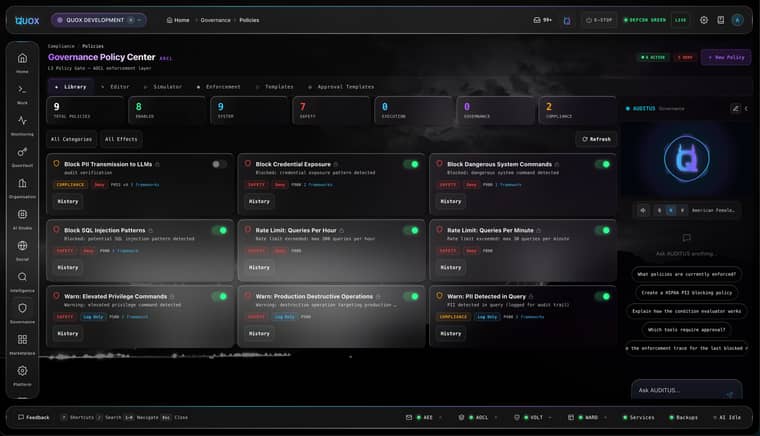
The policy checkpoint every envelope routes through.

AOCL checks each envelope against policy before it moves, and every policy change is logged with actor, diff and reason, held behind an opt-in 4-eyes approval gate.

The Quox policy centre, showing policy management for agent governance

No trust required

Verify it yourself.

Run the offline verifier against the chain. It checks every block, every signed tip and every timestamp on your own machine, with no call home to us.

$quox ward verify --org acme --offline

checking 4,213 blocks · 0 mutations
chain VERIFIED ✓

For a review

Evidence bundles.

Export the paperwork a review actually asks for, backed by the chain rather than by a policy document.

SoAStatement of applicability, mapped to evidence
DPIAData protection impact assessment exports
PackEvidence packs an auditor can verify themselves
The full story, for auditors

Capability matrix

What governance covers

Policy enforcement for AI agents is the enforcement half of governance: deciding, per action, what an agent may do, and proving what it did. This is what the platform covers today, and where each capability's evidence lands.

CapabilityWhat it doesWhere the evidence landsDeep dive
Policy enforcementAOCL checkpoints gate agent actions before they run: deny policies hard-stop the action, hold policies block execution until a named human decides, and the gate fails closed on evaluation error.Logged in the AOCL trace, layer by layer.
Human approvalA sensitive action pauses mid-run and waits in one approval inbox until a person decides.Who decided, what and when, written to the run's evidence record as an approval receipt.
Evidence chainEvery governed step is signed at emit and re-verified on receipt, then appended to a hash-linked, tamper-evident chain.The VOLT ledger, with tips published and witnessed on WARD.
Audit exportEvidence is packaged into bundles built for external review, not assembled by hand when the request lands.Exported evidence bundles, each carrying a WARD-signed manifest hash.
ContainmentE-STOP halts a single agent, DEFCON steps the whole instance down, and the halt itself has to be proven, not assumed.The kill switch's own evidence record: what fired, what it stopped, who authorised it.
Spend controlA budget cap sits on the control plane, before the action runs, not on a monthly invoice reconciled later.The same trace as any other containment decision, not a separate ledger.
Fleet governanceThe same checks apply whether one agent is running or a hundred, so nothing starts ungoverned.A fleet-wide evidence register, not a per-agent average.

The audit trail

Every governed operation, logged as it happens.

Each entry is a VOLT trace, hash-linked to the one before it, so the record is built while the work happens rather than reconstructed afterwards.

The Quox activity and audit log dashboard, showing a chronological trace of governed operations

Who it is for

What this means for you.

The same chain of evidence, read three ways.

01

Compliance officer

Export WARD-signed PDFs across 7 frameworks (SOC 2, HIPAA, GDPR, ISO 27001, EU AI Act, ISO 42001, NIST AI RMF) with one click. SoA Builder, DPIA and Risk Classifier built in. Every policy change is logged with actor, diff and reason, with an opt-in 4-eyes approval gate per mutation.

02

Security engineer / SOC

Runtime policy denials become first-class incidents: auto-triaged, assigned and fanned out to your SIEM. Behavioural baselines per agent catch drift before it matters. Replay any trace layer by layer, and simulate policy changes with What-If.

Splunk HECSentinelWazuhCEFHMAC webhook
03

External auditor

A dedicated portal with PBC auto-match, pre-populated working papers and chain-of-custody verification. Every PDF carries a WARD-signed manifest hash you can verify independently: one trust anchor across envelopes, runs and reports.

The full auditor experience

Read at a glance

One monitor, consistent with what the chain actually shows.

Policy denials, behavioural baselines and 4-eyes approvals all feed the same status: what you see here is only ever what AEE and AOCL have already recorded, org-wide.

The Quox governed monitor, reading fully green and consistent with the org's AEE and AOCL evidence

Seven frameworks

Mapped to the frameworks your auditors ask for.

Evidence from the chain, exported against the seven frameworks the Compliance Suite covers, filling the sections your telemetry can evidence and marking the rest action-required.

SOC 2 Type IIISO 27001:2022GDPRHIPAAEU AI ActISO/IEC 42001:2023NIST AI RMF 1.0

Read honestly

Posture surfaced as it is, gaps included.

The same chain that exports against seven frameworks will show you where a control falls short, not only where it is met. A gap on this dashboard is real, and it stays until closed.

The Quox posture dashboard, honestly showing a coverage gap rather than a false all-green reading

Pricing

Open protocols. Commercial plugins. Simple pricing.

The protocols and the core platform are free. The compliance tooling on top is paid.

Developer Kit

Free

For engineers building custom AOCL layers.

  • Custom processing layer SDK
  • Layer Playground for isolated testing
  • Hot-reload development
  • Plugin marketplace access
  • Email support
Get the Developer Kit

Core Platform

Free

The protocols are open. The platform is free to start.

  • AEE, AOCL, VOLT and WARD protocols
  • 11-layer processing pipeline
  • Hash chain audit trail
  • JSON compliance export
  • Community support
Read the docs

Bundle both for a 15% discount. Volume pricing available. Talk to sales

Questions

Asked often, answered plainly.

How does Quox help you meet SOC 2 Type II requirements?

The Compliance Suite generates evidence bundles mapped to each Trust Services Criteria (CC1–CC9). VOLT traces provide the continuous monitoring evidence auditors need, and the evidence is collected automatically rather than in spreadsheets.

Can we deploy in an air-gapped environment?

Yes. The control plane, policies, memory, secrets and evidence chain run entirely on your infrastructure, and licence activation supports offline mode. Inference runs where you choose: fully local for an air-gapped deployment, or through a model provider you explicitly configure.

How are agent actions made immutable?

Every operation produces a VOLT trace entry with a cryptographic hash chain. Each entry references the hash of the previous entry, so any modification breaks the chain and is immediately detectable.

How does external publication work?

Every 100 WARD entries, a signed Ed25519 checkpoint is published to an RFC 3161 timestamp authority (FreeTSA.org by default). GitHub, GitLab, S3 Object Lock, webhooks and Gitea are also supported. No extra infrastructure required.

Do the Compliance Suite and Developer Kit stack?

Yes. The Developer Kit is free and is for building and testing custom AOCL layers; the Compliance Suite covers audit exports and production layer runs. There is no bundle to discount because the kit costs nothing.

What support is included?

Email support at [email protected], for the Compliance Suite and the Developer Kit alike. We do not quote a response time or promise named staff, because neither is something we can stand behind yet.

What is AI agent policy enforcement?

Policy enforcement means an agent action passes a policy checkpoint before it runs: allowed actions proceed, actions matching deny policies are hard-stopped, and actions matching hold policies block until a person decides, with the gate failing closed if evaluation errors. In Quox this is the AOCL control layer, and every decision lands in the evidence chain.

Open protocol specificationsOpen protocolsSelf-hostable

The evidence layer

Four protocols. One audit trail.

You do not trust the agent, you check it. Start with the protocol drafts, or talk to us about governance for your deployment, part of the wider Quox enterprise platform.