

Honest gaps get filled
No receipts, no claim. Honest gaps get filled.
There is a screenshot on our agent honesty page that we almost did not publish.
In it, our orchestrator is asked a simple question: list my organisations and their divisions. Any demo-minded AI would have obliged. The shape of the answer is obvious, the names are guessable, and the user would probably have nodded along.
Instead, CommanderQ said it had no tool in that session that could enumerate organisations, that it would not invent them, and then offered two real ways to get the answer. The routing chips above the reply show its first-choice model failing over to a second provider mid-request. Nothing about the moment was flattering.
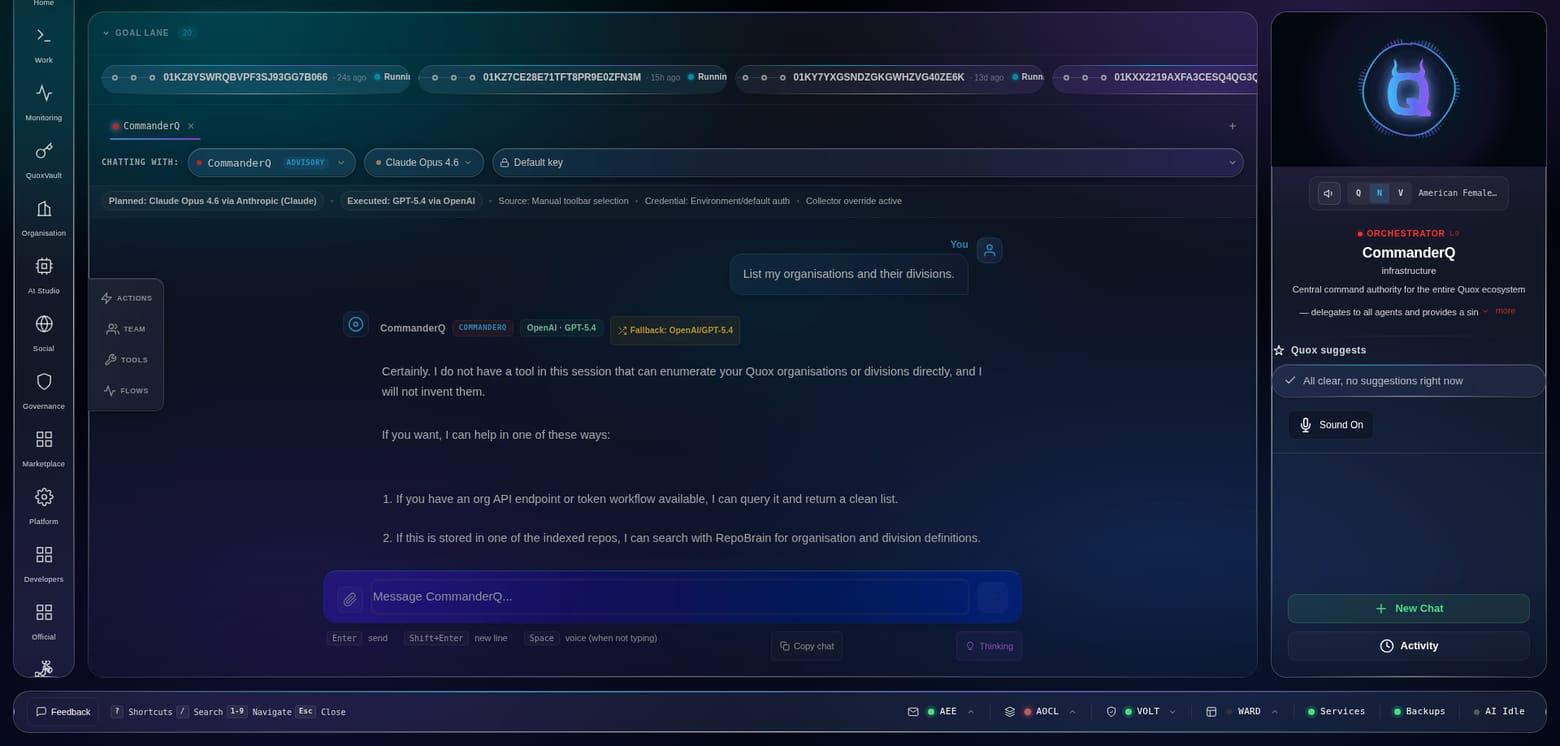
We shipped the missing tool the same afternoon.
That ordering matters more than either half on its own. The refusal was not a safety veneer doing theatre. It was an accurate report from inside the system about what the system could not do. And because the report was accurate, the fix was obvious, small, and immediate: an org directory tool, scoped to what the asking user is allowed to see, tested and deployed before dinner.
A fabricated answer would have cost us nothing that day and everything later. The gap would still exist, invisible, waiting for a customer to fall into it.
Too many secrets
The same week, we audited our own environment configuration. The results were humbling. Three hundred and fifty six variables across ten services. Thirty six behaviour switches reachable only by editing files no user will ever open. Ten of them hid entire shipped capabilities: cross-session memory recall, overnight knowledge consolidation, whole ingestion connectors, the honesty guards themselves.
Features we had built, tested, and then buried so thoroughly that the person who commissioned them did not know they existed.
We named the cleanup rule after the anagram in Sneakers: Setec Astronomy. Too many secrets. The rule is now written into the repository itself: no feature ships with only an environment flag. If it exists, it is visible in the dashboard, settable where a user would look for it, documented, and explained. A capability nobody can see is not a capability. It is a liability with good intentions.
Honesty is a roadmap generator
Put those two stories together and a pattern appears that we think matters beyond us.
When an agent fabricates, it papers over the exact information you need to improve it. The gap stays hidden, the roadmap stays speculative, and the team builds what it imagines users need. When an agent refuses honestly, it hands you a defect report with perfect provenance: this capability, missing, at this moment, for this real request.
Our honesty chain makes that structural. Claims about the past are checked against recorded evidence before a reply ships. What cannot be proven is rewritten with a correction, in the open, and the correction itself lands on the ledger.
The consequence took us by surprise, although it should not have. Honest agents generate the most accurate backlog we have ever had. Every refusal is a feature request with receipts. Every correction marks a place where the system's story and its evidence disagreed. The screenshot that embarrassed us was, in the most literal sense, our product doing product management.
The demo is the audit
Most AI products are built to demo well and audited under duress. We think that ordering is backwards, and the evidence layer we build exists to reverse it: envelopes on every message, layer records on every request, a verifiable ledger of what actually executed, receipts witnessing the lot.
On that substrate, honesty stops being a policy and becomes a property. The agent does not claim the report was filed. It points at the filing.
A culture follows from the plumbing. Corrections rewrite rather than block, because hiding a mistake is worse than making one. Escalation deadlines can expire, reassign, or deny, but silence never becomes consent. An agent granted the power to resolve approvals proposes, and a human confirms. None of this slows the system down in any way that matters. It slows down the lying.
What it points towards
We think the ceiling on how much intelligence you can safely deploy is set by the floor of how honestly it reports itself. Raise the floor and the ceiling follows.
The platforms that win the next few years will not be the ones with the most impressive answers. They will be the ones whose answers survive being checked, and whose gaps get found by their own software before their customers find them the hard way.
So the screenshot stays on the page, refusal and all, with the caption it earned: it would have been easy to invent something plausible. Instead the system told the truth, and the truth got a tool shipped by sunset.
No receipts, no claim. Honest gaps get filled.
Deploy QuoxCORE — free, self-hosted
AI agent orchestration with built-in governance. Docker Compose up and running in under five minutes.