
QuoxCORE components · governance
Don’t build your own guardrails.
Policy, approvals and spend control for autonomous work. The part everyone underestimates, and the reason agent projects stall at the demo.
Included in QuoxCOREFree, self-hosted, nothing to buy.
Build it yourself and you are signing up for
- A policy engine that runs before executiondeclarative rules evaluated on every action, not advisory logging after the fact
- Approval routing with real deadlinesthe risky step waits for a person, and nothing auto-approves on timeout
- Spend metering that can stop a runcost, tokens and tool calls, capped per organisation, objective, execution and iteration
- Change control on the controls themselvesstaged policy edits with second-approver sign-off, or the guardrails are just config
Or install QuoxCORE. All of it is already there.
In plain words
What it is, where it lives, when to reach for it
- What is it
- The control surface of QuoxCORE: declarative policies, approval routing and enforced spend budgets over agent actions.
- Where do I use it
- In the dashboard governance pages, and in your terminal through
quox governance policyandquox budget. - When would I use it
- When agents get real access and you need limits that hold without you watching every run.
- How do I use it
- Budgets are one command:
quox budget create. Policies are managed withquox governance policyor the dashboard.
QuoxCORE is the free, self-hosted platform underneath this. What is QuoxCORE
the term, defined
AI governance for autonomous agents.
AI governance for AI agents defines which actions they may take, when they need human approval, and what resources they may spend. For autonomous agents those controls have to decide whether an action can run before execution begins, not report on it afterwards.
Quox evaluates declarative policy rules on every action before execution, and the workflow engine carries the same permission check on any step. Governance is bundled with QuoxCORE, with no extra licence or install, and every gate decision lands in the evidence layer while requests for human approval route to the HITL inbox.
policy & guardrails
Decided before it runs.
Rules are declarative and evaluated ahead of execution: what may run, what pauses for a person, what is refused outright. The workflow engine carries the same gate on any step, so a policy is a checkpoint, not a comment. It is the same permission-check-before-execute pattern set out in agentic AI.
Changing the rules is itself governed: policy edits can be staged for a second approver to sign off, and template packs give you a starting set instead of a blank page.
quox governance policyDashboard: Governancequox governance template lists the policy packs; quox governance approval handles staged sign-off.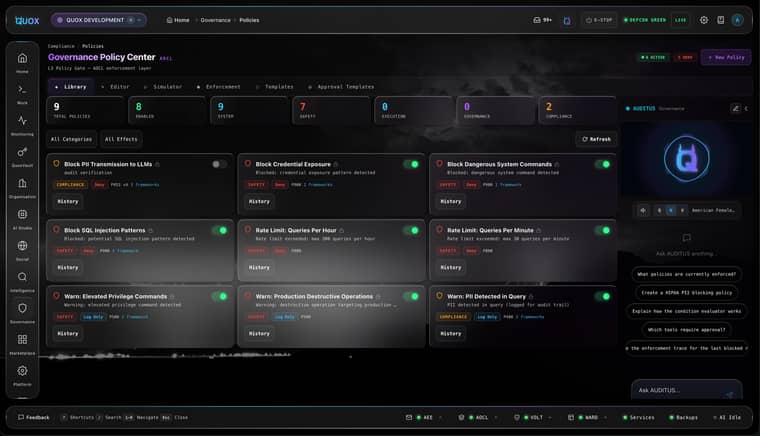
budgets & limits
Caps that hold.
Budgets attach at four scopes: organisation, objective, execution and iteration. Each caps cost, tokens and tool calls, and the hard stop terminates a run that breaches it rather than politely logging the overrun.
The iteration scope exists for loops: one runaway turn cannot spend what the whole execution was given.
quox budget createDashboard: Governancequox budget usage shows rolled-up spend with a daily breakdown per budget.$ quox budget create --scope org --max-cost-usd-micro 250000000 \--max-tool-calls 50000 --period-start 2026-09-01 --period-end 2026-10-01hard_stop yes$ quox budget listScope Period Max Cost (micro-USD) Hard Stoporg 2026-09-01 to 2026-10-01 250000000 yes
Governance in action
Watch the gate decide.
Policy and budget checks run before an action, not after. Toggle the policies and see how the same three actions are allowed, paused for a person, or hard-stopped, each decision recorded before execution.
policies · evaluated for every action
decisions · one per action, recorded before it runs
customer.readALLOWEDno matching restriction · a read is permitted
order.4021.address.writePAUSEDheld for human approval · no auto-approve on timeout
run.spend.4.20HARD-STOPPED$3.10 + $4.20 = $7.30 over the $5.00 cap · terminated before spend, not logged after
Where it sits
Between intent and action.
Bundled with QuoxCORE; the guardrails are not an add-on. Approvals route to the HITL inbox, and every decision the gate takes lands in the evidence layer below.
AI governance, answered
Common questions about AI governance.
What is AI governance?
AI governance sets the rules, responsibilities and controls for how people build and use AI. AI governance for agents applies those controls to systems that take actions autonomously. Quox enforces declarative policies before each action runs and records every gate decision in its evidence layer.
What is the difference between AI governance and AI compliance?
AI governance defines how an organisation directs and controls AI, while AI compliance concerns meeting applicable requirements, such as laws and contractual obligations. Quox provides execution controls and evidence of gate decisions that can support compliance work. Those controls do not, by themselves, establish compliance.
Can AI governance be self-hosted, or does it require a cloud service?
AI governance does not have to run as a cloud service. Quox is a self-hosted control plane: QuoxCORE installs on infrastructure you operate, and the governance controls come bundled with it, so policies, approvals and budgets run on your own instance. Keeping the control plane self-hosted means the policy decisions and their evidence stay on your side rather than a third party’s.
What does AI governance actually control for an AI agent?
Quox’s AI governance controls action permissions, human approvals and resource budgets. Declarative policies run before every action, and risky steps wait for a person through the HITL inbox, with real deadlines and no automatic approval on timeout. Budgets at organisation, objective, execution and iteration scopes each cap cost, tokens and tool calls, and a hard stop terminates a breaching run. Policy edits can also be staged for a second approver to sign off, with template packs providing a starting set.
Does adding AI governance slow agents down?
AI governance adds checks before execution, so it is not zero overhead. Quox evaluates every action before it runs; risky steps that require approval wait for a person, and a hard budget stop terminates a breaching run. Routine actions that pass the controls proceed without a human approval pause, and an approval deadline never triggers automatic approval.
Ready when you are
Give agents room, not rope.
Policy, approvals and budgets ship in the box with QuoxCORE: no extra licence, no extra install.